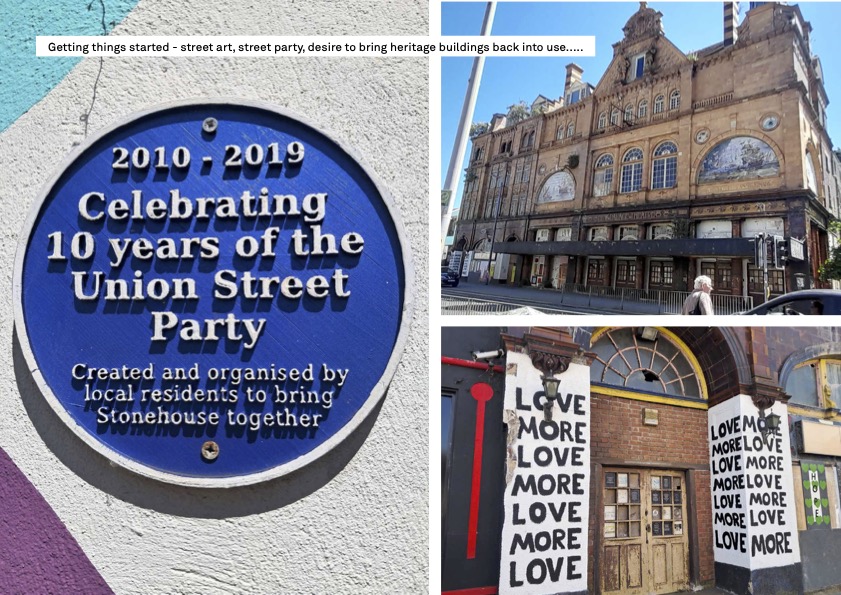
The High Streets Working Group is part of the project that is Transforming Filwood Broadway. The Working Group are made up of a number of different representatives including, local residents, Bristol City Council, Knowle West Alliance and is led by Architect 00. The group is focussing on the future and regeneration of Filwood Broadway. As part of that work, the group have looked at other community led initiatives, including, Nudge Plymouth. Nudge is a community led project focussing on empty buildings on Union Street in Plymouth.
“We had been volunteering in our community for over 10 years. We kick started the Union Street Party, created Union Corner and were inspired and asked by our community to do more about empty buildings.
Five years on we have unlocked 25% of the empty buildings along Union Street and offered spaces for local people to grow” Nudge Plymouth
At the end of May, local resident Ian Watt and members of the Architect 00 team and representatives from Bristol City Council visited the Nudge project in Plymouth. Ian wrote the following:
“As a resident in Knowle West, I was inspired and impressed with the work of Nudge Builders. It is clear that the co-leaders of this project had initiated a lot and invested an initial amount from their own money, but this had come from a long journey of engaging in the area. The area around Union Street has a long history of entertainment and cinemas/pubs/nightclubs/theatre. This spans a considerable time, but the area became a negative focus and policing was difficult. The response to this led to many nightclubs shutting down, and maybe cultural changes impacted the popularity of some venues that had re-invented themselves multiple times over the years.
Although very different to Knowle West and Filwood Broadway, I think the following general points highlighted some key themes to learn from for us in the Knowle West community.
Can-do leadership
It was quite surprising that the local Council had not responded to the work there, and the width of voluntary input and financial investment, as much as I would have imagined.
There is clearly a very difficult challenge for a local Council to deal with buildings that have sat empty in some cases for decades. The scale of the buildings and the problems and risks associated are clearly on a grand scale. But innovative approaches are possible and they are not carrying the risk as a Council to see these materialise.
Despite numerous setbacks, I see the need for a good level of advocacy on behalf of a community that has clear leadership, prepared to take risks and develop ideas and seems exemplary in tackling projects that seem daunting.
Often a very risk adverse approach does not offer innovative ways to release buildings and transform areas. But it needs fresh thinking and this was obviously present.
Scale and timescales
I noted that the willingness to take on large projects was also around being prepared to take them at pace, not feeling that it is an overnight win, and hearing fresh ideas from the community that can be delivered. It is easy to believe that spaces are too much to take on, but they can be shared. It is also easy to believe that an initial concept is not thought through, but re-assessing ideas that are working (or not working) is okay. Nudge seemed to recognise that setbacks were not the end of projects, nor were things that didn’t succeed. They seem to realise that you have to keep working on a plan over decades and not a five year plan for example.
Buy –in
Groups and individuals have many options and the community shares, with an option for a low bar of investment, meant that volunteers can be rewarded, large and small scale investors can be able to receive a level of return and the risk of developing a difficult site can be spread as widely as possible. Community buy-in as widely as is feasibly possible, is a good approach to decrease risks. Clearly some have taken higher risks than others, but widespread sources of funding seemed particularly key.
Where do I fit?
There was a strong sense of opportunities afforded to a wide variety of people, who had options to fit into the vision. The shared ownership of the area (as central and historical to many people’s lives in Plymouth) helped this. Many people need to understand where they fit in a community vision. They need to feel it is ‘their’ project and their community represented too (which it is, whether they have a long or short history in the area).”
To know more about Transforming Filwood Broadway click here. Watch the explainer video here. Get in touch or get involved contact FilwoodLUF@bristol.gov.uk
Photo credits: Architect 00

 Knowle West Alliance